
New
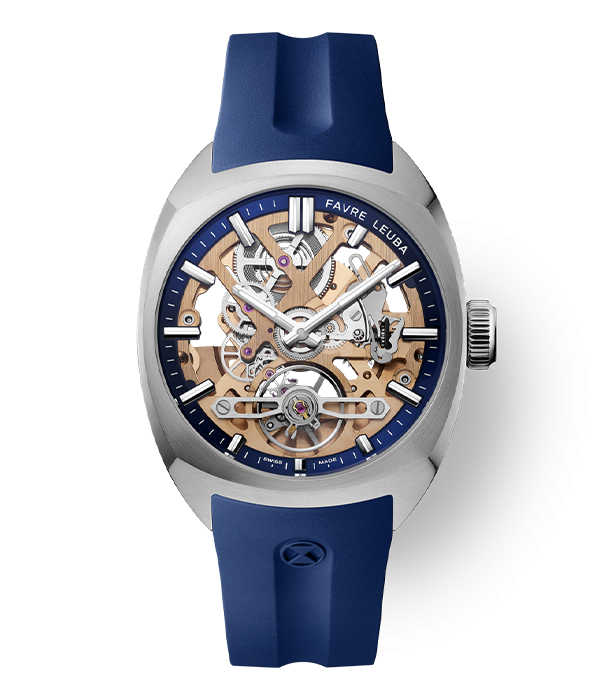
Favre Leuba Chief Skeleton Blue 00.20105.103.02.302
Favre Leuba Chief Skeleton Blue 00.20105.103.02.302
Available to Order!
Inquire In stockCouldn't load pickup availability
- Authorized retailer for 5 brands
- Contact specialist via email
- Free Two-Day Expedited Delivery
- Authenticity Guaranteed
Details
Details
In 2025, Favre Leuba deepens its pioneering legacy with the introduction of some of the most technically sophisticated and visually captivating timepieces in its history. At the forefront stands the Chief Skeleton, the brand’s first-ever skeletonized creation inspired by the iconic Chief case design of the 1970s. This bold debut pays homage to the brand's heritage while marking a defining milestone in the enduring journey of one of the world’s oldest watchmakers.
The bold skeletonized dial marks Favre Leuba’s first step into the art of skeletonization. At its center lies a striking view of the movement, where minimalist timekeeping elements highlight the exposed mechanism.
The essential time indicators sit on the outer flange. Minute markers are printed, while applied hour markers feature rustic rhodium plating with a polished finish. The hands mirror these details with rhodium plating, polished surfaces, and sandblasted grooves.
Features
Features
Reference: 00.20105.103.02.302
Dated: 2025
Bracelet: Blue Rubber Strap
Case: 40mm x 11.76mm Thickness - Stainless Steel
Lug Width: 22mm
Movement: FLS01 - Automatic
Functions: HMS
Box and Papers: Inner/outer boxes, and warranty card
Crystal: Sapphire
Water Resistance: 100M
Bracelet size: 7.5”
Condition
Condition
New
Brand History
Brand History
Favre Leuba traces its roots back to 1737 in Le Locle, Switzerland, when Abraham Favre is documented as running his own watchmaking workshop.
Over the next generations, his descendants expanded the firm: in 1792 a formal firm “A. Favre & Fils” was established, and by 1815 Henry-Auguste Favre partnered with Auguste Leuba, coalescing into the name Favre-Leuba.
The brand became known not just for fine complications and precise movements, but for technical innovation: in the 1950s and 60s, Favre Leuba developed proprietary calibers (FL101, FL103/104) and produced landmark tool watches such as the Bivouac—the first mechanical wristwatch combining altimeter and barometer—and the Deep Blue diver’s watch.
However, the quartz revolution of the 1970s–80s strained many traditional mechanical watchmakers, and in 1985 the Favre family was forced to cede control of the company.
Over the years the brand passed through various owners, including stints with LVMH and, later, Titan (of India).
Ethos Watches
In recent years, Favre Leuba has attempted revivals and re-launches: in 2011 Titan acquired it, and as of 2024–2025 it is undergoing yet another revival with fresh watch collections, renewed branding (dropping the hyphen), and an eye toward reconnecting with its heritage—particularly its longstanding ties to India.