

Pre-Owned
Baume & Mercier Capeland Chronograph XL 44mm 65716 Blue Dial
Baume & Mercier Capeland Chronograph XL 44mm 65716 Blue Dial
In stock and ready to ship
Couldn't load pickup availability
- Authorized retailer for 5 brands
- Contact specialist via email
- Free Two-Day Expedited Delivery
- Authenticity Guaranteed
Details
Details
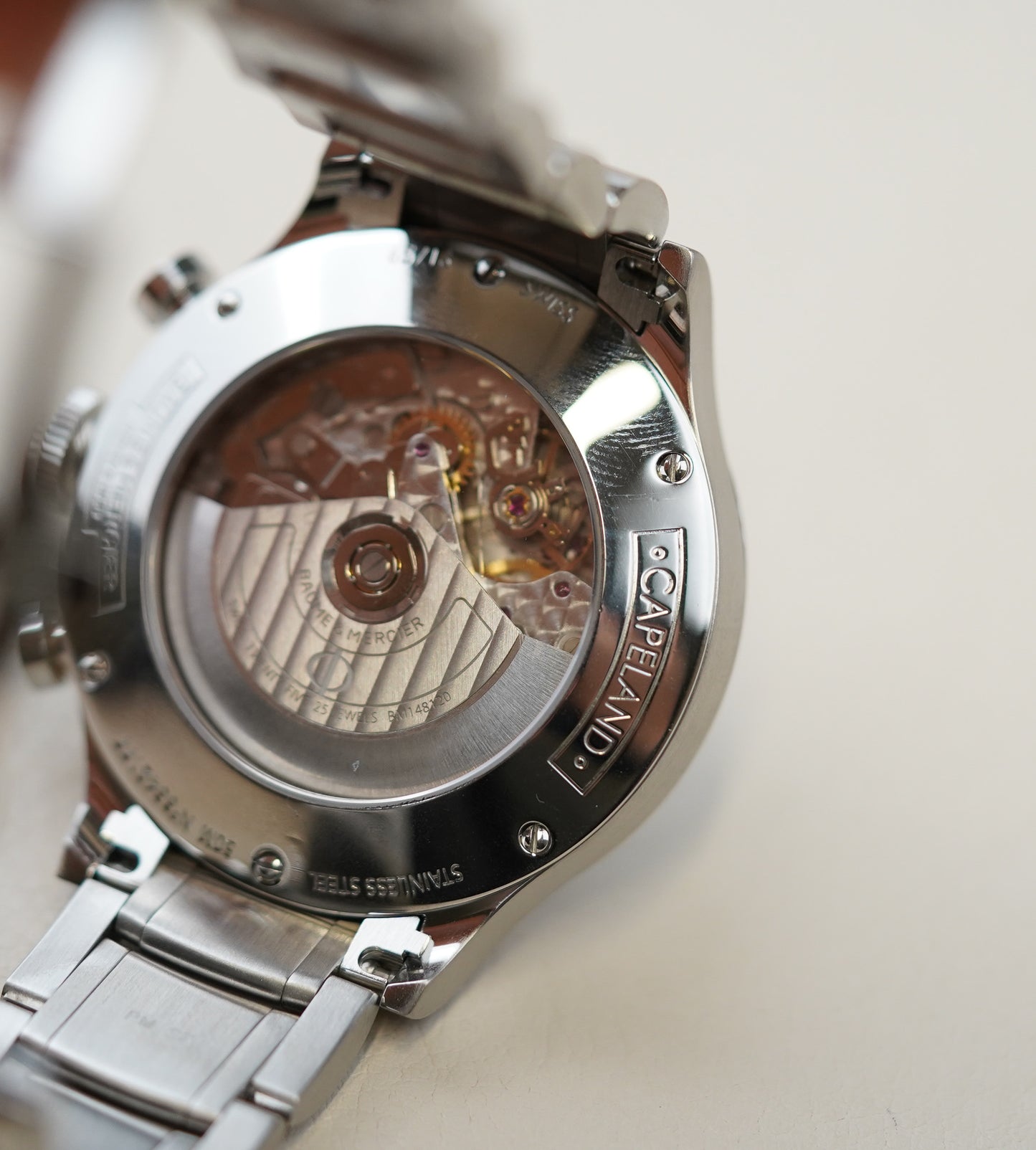
The Baume & Mercier Capeland Chronograph XL 44mm (ref. 65716) is a modern take on traditional chronograph design, blending sporty functionality with a more refined, almost dress-leaning aesthetic. Its 44mm stainless steel case gives it strong wrist presence, while the deep blue dial—paired with a tri-compax subdial layout and date at 4:30—keeps the look balanced and legible. A sapphire crystal and polished case details add a level of finish that separates it from more purely tool-focused chronographs.
Under the hood, it runs on an automatic chronograph movement (BM14xx family) with roughly 42 hours of power reserve, offering reliable everyday performance. With 50 meters of water resistance, it’s not a dive watch—but that’s not the point. The Capeland line leans into a heritage racing chronograph vibe, combining vintage-inspired proportions with a polished, contemporary feel.
Features
Features
Reference: 65716
Bracelet: Stainless Steel Bracelet
Case: 44mm - Stainless Steel
Movement: Automatic
Functions: Hours, Minutes, Seconds, Date, Chronograph
Box and Papers: No box or papers - watch only
Crystal: Sapphire
Bracelet size: 7.5”
Condition
Condition
Case has little to no wear. Bracelet has little to no wear. Dial, hands, and crystal have no wear.
Brand History
Brand History
Seiko's history began in 1881 when Kintaro Hattori opened a watch shop in Tokyo. In 1892, he established Seikosha, a factory for producing wall clocks. The company quickly progressed, creating Japan's first wristwatch, the Laurel, in 1913. Despite setbacks like the Great Kanto Earthquake of 1923, Seiko persevered, launching its first watch under the Seiko brand name in 1924.
The post-World War II era saw Seiko's rapid growth and innovation. They introduced Japan's first automatic wristwatch in 1956 and launched the prestigious Grand Seiko line in 1960. Seiko achieved international recognition for accuracy in 1968, winning a Geneva Observatory competition.
The company made a name for its divers in 1965 with the introduction of their first professional dive watch, the 62MAS. This was followed by the iconic 6159-7001 in 1968, which was water-resistant to 300 meters. Seiko gained international recognition in 1975 with the release of the 6159-7010, nicknamed the "Tuna Can" due to its distinctive case shape. In 1969, they revolutionized the industry with the Astron, the world's first quartz wristwatch, ushering a new era of watchmaking that would send waves across the industry through the 70s and 80s. From its humble beginnings to becoming a global watchmaking giant, Seiko's history is characterized by resilience, technological advancement, and a commitment to precision.