

Pre-Owned
1972 Omega Speedmaster 145.022-69 'Prototype Alaska III Radial Dial'
1972 Omega Speedmaster 145.022-69 'Prototype Alaska III Radial Dial'
In stock and ready to ship
Couldn't load pickup availability
- Authorized retailer for 5 brands
- Contact specialist via email
- Free Two-Day Expedited Delivery
- Authenticity Guaranteed
Details
Details
The 1972 Omega Speedmaster Professional Ref. 145.022-69 is a fascinating vintage chronograph that combines the classic character of an early post-Moon Speedmaster with two of the most unusual design elements associated with Omega's experimental watchmaking: an Alaska III-style radial dial and a distinctive decimal bezel. Housed in the iconic 42mm asymmetrical stainless steel case, the watch features twisted lyre lugs, protective crown and pusher guards, and the unmistakable proportions that helped define the Speedmaster Professional. While the standard 145.022-69 featured a traditional black stepped dial and tachymeter bezel, this example has been fitted with a rare prototype-style radial dial and a decimal-scale bezel, creating a configuration unlike the conventional Moonwatch. The decimal bezel replaces the familiar tachymeter scale with markings that divide one minute into 100 decimal units, allowing elapsed time to be converted into decimal values for scientific, industrial, and technical calculations. Omega historically offered decimal bezels as an alternative to its standard tachymeter, making this configuration an especially interesting expression of the Speedmaster's original purpose as a precision timing instrument.
The story behind the radial dial is closely connected to Omega's secret Alaska Project, an experimental development program initiated in 1969 to improve the Speedmaster's performance in the extreme conditions of spaceflight. By the late 1970s, the Alaska III project had produced a specialized Speedmaster featuring a distinctive black dial with radially arranged numerals within its chronograph subdials. Unlike traditional Speedmaster registers, where the numerals remain horizontally oriented, the radial design positions them around the perimeter of each subdial to improve readability. The Alaska III would eventually become associated with NASA's Space Shuttle program, with 56 specially configured watches documented as having been delivered for NASA use. This particular Speedmaster brings that experimental design language to an earlier 145.022-69 case, combining the radial dial with the technically unusual decimal bezel. Together, these features create a visually compelling chronograph that reflects Omega's continuing experimentation with legibility, precision, and specialized timing applications during the golden age of space exploration.
Inside is Omega's manually wound Calibre 861, a 17-jewel cam-actuated chronograph movement operating at 21,600 vibrations per hour and delivering approximately 48 hours of power reserve. Introduced in 1968 as the successor to the legendary Calibre 321, the 861 marked a significant evolution in Speedmaster history, offering greater operating frequency and a robust chronograph mechanism that would remain central to the Moonwatch for decades. The movement powers the traditional three-register chronograph layout, with running seconds at 9 o'clock, a 30-minute counter at 3, and a 12-hour counter at 6. The combination of an early Calibre 861 Speedmaster, separately installed Alaska III-style radial dial, and uncommon decimal timing bezel creates a particularly distinctive watch for collectors interested in the lesser-known chapters of Omega's technical and experimental history. While this example is not presented as an originally NASA-issued Alaska III, its unusual configuration pays tribute to the innovations that emerged from Omega's longstanding relationship with space exploration and precision chronograph development.
So far we have observed less than 10 of them, with private collectors, or very rarely available for sale". -Watchfid
Features
Features
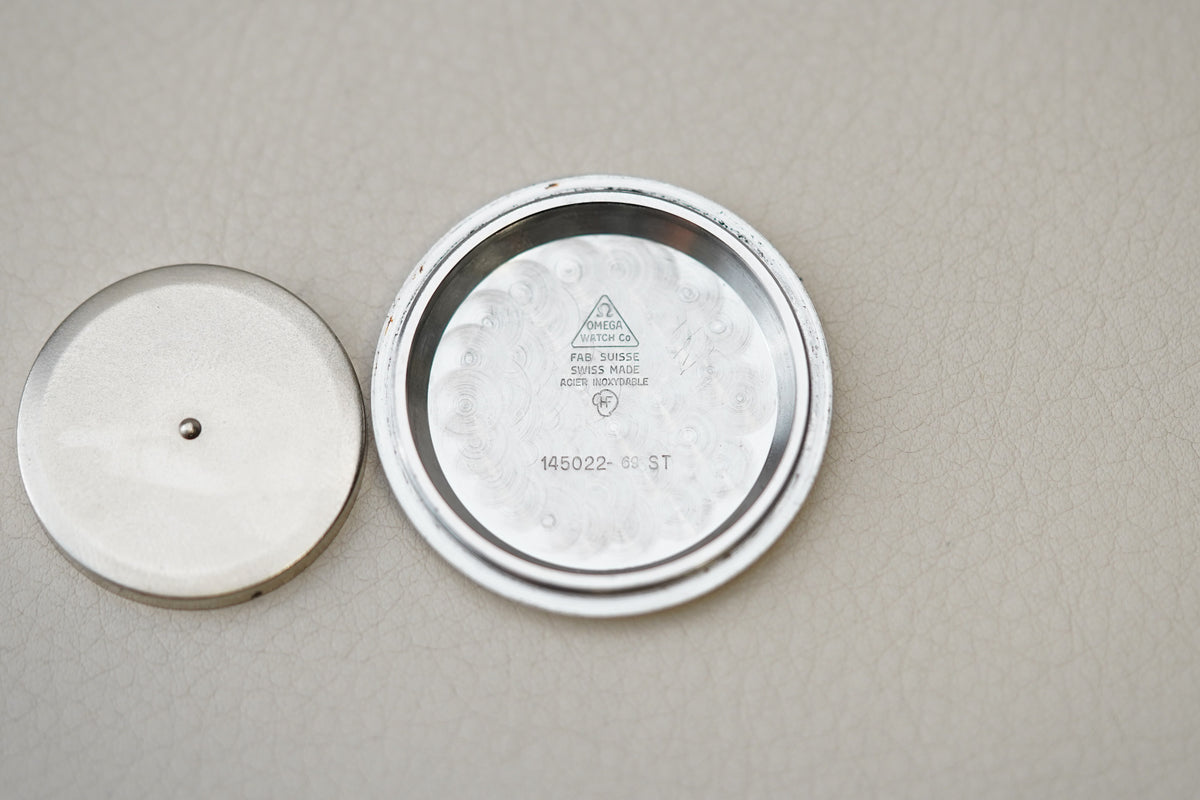
Caseback Reference: 145.022-69
Movement number: 31,006,XXX
Movement Dated: 1972
Dial: 'Alaska III Radial Dial' - Tritium - indices have become a perfect pumpkin patina
Hands: Luminova
Bezel: Decimal Bezel
Strap: Brown Leather Fratello x REM Strap - Spaceship
Case: 42mm - Stainless Steel
Lug Width: 20mm
Movement: 861 - Manual - Running (+4 s/d 275 amp)
Functions: HMS, Chronograph
Accessories: N/A - Watch Only
Crystal: Hesalite
Bracelet size: 7.75”
Condition
Condition
Case has minimal wear. Strap is in great shape with slight creasing. Dial has no wear with perfect beige patina. Hands are replacement luminova hands. Running (+4 s/d 275 amp).
Brand History
Brand History
Founded in 1848 by Louis Brandt in Switzerland, Omega has grown into one of the most respected and innovative names in watchmaking. The brand’s early focus on precision earned it accolades at international observatories and competitions, setting the stage for decades of horological achievement. Omega became the official timekeeper for the Olympic Games in 1932, and in 1969, the Speedmaster Professional—nicknamed the "Moonwatch"—made history as the first watch worn on the lunar surface during NASA’s Apollo 11 mission. Omega’s innovations continued with the introduction of the Co-Axial escapement in the late 1990s, a groundbreaking movement that dramatically reduced friction and improved long-term accuracy.
Omega’s lineup showcases a wide range of iconic models that reflect the brand’s legacy and versatility. The Seamaster, introduced in 1948, is a favorite among divers and famously worn by James Bond since 1995’s GoldenEye, blending technical capability with cinematic cool. The Speedmaster remains one of the most storied chronographs in existence, while the Constellation is known for its refined design and chronometric precision. The De Ville collection offers a more elegant, dress-focused aesthetic, often featuring high-end complications and meticulous finishing. Omega continues to lead with innovations like Master Chronometer certification, METAS testing, and antimagnetic technology—ensuring that its watches are not just beautiful, but built for the demands of modern life.